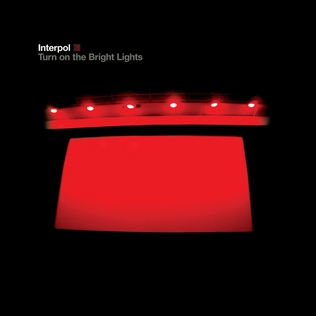
24 years on, Interpol’s debut LP still stands firm as one of the defining albums in the 00s indie revival.
It’s 2002, and New York City has quickly become the hotbed of the Indie rock revival. Nu-metal was still dominating the commercial charts, but 2001 had brought the quickfire releases of The Strokes’ debut masterpiece Is This It and The White Stripes third LP White Blood Cells. It felt as though the tide was about to change; angsty dudes in jorts are out, skinny dudes in bomber jackets are in. The lingering hangover of the bygone Generation-X pessimism was beginning to dissipate, paving the way for an incoming generation of artists to forge a new musical identity which would later become collectively known as indie-rock. But amongst the fervent youth optimism of the new millennia was something more pensive and cinematic, a collective of ideas yet to be realised. When philosophy students Daniel Kessler and Carlos Dengler met in a class at NYU, these ideas began to synthesise. Singer Paul Banks would soon become involved, and with eventual drummer Sam Fogarino these straight-edge anglo-looking rockers would become the architects of a new sub-strand of the 00s zeitgeist which would be defined by an increasingly emotionally despondent youth. Sounds a bit like Interpol’s target audience, no?
While they were both proud custodians of New York, and shared the same stages and festival lineups, The Strokes and Interpol couldn’t have been further apart musically. Julian Casablancas and co were out to show the world that the new millennia would usher in the second golden age of the CBGB, and bring back fun, catchy rock music in the process. Stylistically, The Strokes dressed and behaved exactly as their music sounded; effortlessly suave and full of playful verve. On the contrary, Interpol donned black suits and conducted themselves with a sombre sincerity which too made them seem like detached indie mourners wandering about a wake, personifications of their lugubrious post-punk sound. If The Strokes were indebted to the likes of Television and The Velvet Underground, then Interpol’s early influences were anglo, borrowed from across the Atlantic (perhaps this shouldn’t be surprising given both Paul Banks and Daniel Kessler originally hail from England).
With that, let’s address the elephant in the room. Yep, the Ian Curtis & Paul Banks similarity. You have to sympathise with Interpol, as such an unanimously accepted parallel can also feel accusatory; as if using Banks’ likeness to Curtis was some thinly veiled attempt to over-compensate for a complete lack of artistic originality. And in truth, there is something to be said for the comparison; both in voice and look, Banks was a dead ringer for the former Joy Division frontman. But to call Interpol’s sound a direct pastiche of post-punk’s most famous group would be unnecessarily reductive. Their debut album breathes with a life of its own and owes as much to the shimmering, delay soaked guitars and emotional but restrained vocals of The Chameleons 1983 Script of the Bridge as to any of Joy Division’s material or influence. There’s also the glacial atmosphere of The Cure’s early work, and the minimal arrangement and angular precision of Wire. It’s a true melting pot of post-punk gloom.
Yet the greatest influence to Turn On The Bright Lights isn’t musical at all; it’s the liminal spaces of New York City. Whilst their contemporaries were singing about parties, relative boredom, relationships and all the other staples which make up the urban youth experience, Interpol were exploring something far more abstract. If The Strokes, Yeah Yeah Yeah’s and co were capturing what it felt like to be young, Interpol were documenting how it felt to be alone. The immediately conversational tone of 00s indie isn’t a feature of Banks’ lyrical work; instead, it was fragmented, impressionistic and laden with recurring imagery which pointed to something more emotionally ambiguous that upon first listen, eschews obvious interpretation. Instead, it conjures up visual reveries of empty streets, late night bars and cold architecture, observed through the eye of the detached, lonely wanderer.
Looking at the music itself, there’s a surgical precision to the way songs are constructed. Interpol have long been known for their distinctively ornate music arrangements, which gives the finished product an austere quality which too makes a nod to the Joy Division influence. The album opener Untitled sets the tone with a shimmering guitar riff, which rises before being joined by a powerful bass line from Carlos Dengler; it’s quite an introduction into the ruminative world of Turn On The Bright Lights. Paul Banks told Vice in 2018 that the song had been written specifically to be the opener for their live shows – which seamlessly flows into second track Obstacle 1. The quite deliberate act of world building from the pensive opener helps the follow up to pack some extra emotional punch when it launches into its powerful chorus with Banks crying out ‘but it’s different now that I’m poor and ageing, I’ll never see this face again’. As is unanimously agreed on Reddit, tracks like this are the gold standard for post-punk revival.
There’s a sonic adhesivity which holds the album together even as it moves between the gloomier self-reflective tracks (Leif Erikson, Hands Away) and the bouncier bass line driven tracks (PDA, Roland). Even through these diverging tangents Interpol maintain a theatrical consistency which allows the album to flourish with a life of its own, not bound or restricted by constantly adhering to satisfy its own creative influences. Rather than feeling like simply a compilation of studio recordings, Turn On The Bright Lights captures something which collectively feels greater than the sum of its parts; what that is exactly is open to debate, but it feels like an emotional snapshot of a spiritually disconnected zeitgeist which is simultaneously looking inward and outward with a sense of weighty solipsism. What exactly was casting such a vast psychological shadow over the bustling metropolis of New York City? Oh yes, just the most significant geopolitical event of all time: the September 11th attacks.
The city that never sleeps was still united in collective grief long after the psychologically haunting events of 9/11, suspended in a purgatory of liminal gloom. When Interpol released their debut album to the world in August 2002 they were quick to dispel theorisations that the sombre atmosphere of Turn On The Bright Lights was driven by the horrors witnessed by thousands on the TV and on the streets of Manhattan on that picturesque September morning. Bassist Carlos Dengler told press that these songs were written long before, but admitted that the events did have a profound impact on the band; ‘the unintentional meaning [the songs] take on isn’t any less of a meaning; we were holding the cards to a certain message that was about to become relevant’. Whether the impact of 9/11 did have a material impact of the emotional weight of Turn On The Bright Lights is disputed, but it exists as an inexplicable piece of sub-text which goes a long way to revealing the feeling of irrepressible ephemerality present within the average New Yorkers’ psyche in 2002.
So, what was it about Turn On The Bright Lights that had such a lasting impact? It largely lies in the theatrical style which they popularised. The post-punk revival already existed, but it was Interpol who slammed their aesthetic stamp firmly upon it. The dark-wave of atmospheric indie-rock which came into existence as a result has Interpol to thank for this; most namely British bands Editors and White Lies; perhaps it shouldn’t be a surprise to see where these bands hail from; Interpol have always been an anglo-influenced band capturing the essence of the New York City in a post-punk glass bottle. Although differing sonically, The National’s emotionally restrained but literate indie-rock became mass-marketable thanks to the success of Turn On The Bright Lights. And with the increasing interest in the revival of self-reflective shoegaze inspired indie-rock, who knows how many other young bands have got the famous outro to PDA blasting through their bedroom speakers. Ultimately, it was the New York quartet who added a critical dimension to the indie revival, providing an introspective alternative to the flaneuristic garage-rock revival which relied on constant self-observation of a city alive with possibility. Interpol chose to explore something far more indirect; a city suspended in psychological limbo, laden with possibilities but a protagonist restricted by a soul heavy with spiritual confusion.

