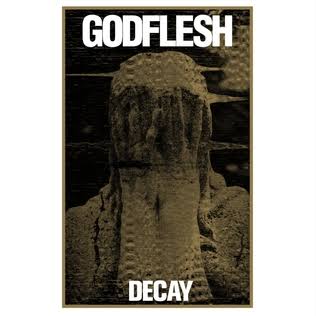
The industrial metal legends bow out, but Justin Broadrick ensures it’s with total cathartic ferocity.
There’s an innate cruelty in seeing legends of their respective fields forced into retirement by factors beyond their control. For Justin Broadrick, who for so long has stood tall with a sonic artillery of music so robust in its mechanical brawn that he seemed invincible, now finds his hand being forced. After surgery early in the year left him with physical scarring, he was told that abandoning his signature growl was not just medically advisable, but clinically imperative.
Sadly, this brings the curtain down on his Godflesh project, which for years has walked the line of extreme metal and industrial music with its own indomitable edge rooted on the bleak imagery of ‘80/90s England’s concrete wastelands. That said, Broadrick himself said it feels like a natural conclusion; although health reasons may be listed as the official cause of death for Godflesh, in reality the Birmingham native felt the time capsule essence of the noise rock project was beginning to feel dated, as he wanted to focus more creative energy on other projects, such as his intriguing shoegaze work as Jesu and full throttle electronic moniker JK Flesh.
Fortunately for those who dabble in the monstrous echelons of heavy music, there is still life in Godflesh; and that’s putting it lightly. It seems they are determined to sign off with their familiarly unsaturated energy, as Decay is a triumphant denouement of sonic power. For Broadrick and bassist/programmer B.G. Green, the aggressive sonics of Godflesh have never been about repurposing the virile machismo of extreme metal, but instead exploring a more alienated fury wherein the very concept of the self is denigrated and deconstructed in a cacophonic symphony of wrath.
Luckily enough, Broadrick had already recorded vocals on their previous album Purge which would be repurposed for Decay; meaning there’s no danger of us being left with a diluted final product which wouldn’t accurately do justice for their already secured legacy in the extreme music arena. The end product is a more experimental work which pulls together all of Godflesh’s original influences into one final synthesis of confrontational dominion. There’s industrial, metal, techno, syncopated hip-hop rhythms and anxiety inducing guitars, detuned and pumping out sludge metal riffs worthy of a vivid nightmare simulation.
Across six tracks and forty odd minutes, there’s a general air of insidious unease. Unlike on previous albums where the metal riffs were more confrontational, the sacrifice of such a formulaic approach gives the album its overall feeling of weighty dread. Opening track Master and Slave trudges along at an unsettlingly slow pace, backed by a preternatural synth line, wobbling bass and crunching guitar riff. In Living/Ending we hear Broadrick’s vocals at their cathartic best, accompanied by a drum machine rhythm and droning sludge riffs.
The album’s mid-section sees the macabre sonics get dialled up a notch, playing up to the general sense of unease. The overwhelming feeling on Feral Colony and Fear of Man is motion sickness, as if you’ve been on a dodgy fairground ride and your ears ring relentlessly as you focus all your energy on not chucking up. It’s an interesting way to acknowledge a band achieving its sonic goals, but there you go. Closing out with a twelve minute descent into the underworld, Consume Me is a satisfyingly terrifying way for Godflesh to bow out of the world, as the physical anguish seems to translate all too clearly in the vocals.
In that sense, the ending seems to come as a relief for Broadrick. Years of punishing his vocal chords in this way have clearly come at some cost to him. For an artist as chameleonic in their output, it’s comforting to know that this won’t be the last we see of him by any means. But in saying that, it’s hard to imagine what could come close to matching the unbound musical fury of Godflesh; without them, the course of industrial sonics could have taken a vastly different path. And for that, we thank him.