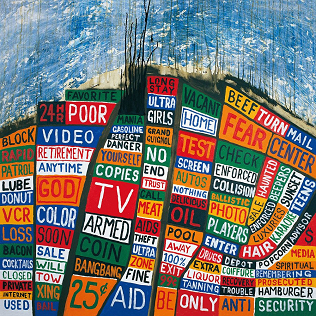
As the RSC’s critically acclaimed intermedia spectacle Hamlet Hail to The Thief arrives in the capital later this month, we revisit the source material which inspired it. And no, not the Shakespeare play.
Radiohead guitarist Ed O’Brien once famously told Rolling Stone that Hail To the Thief was ‘the first album where, at the end of making it, we haven’t wanted to kill each other.’ This window of insight into the usual tribulations of recording music alongside Thom Yorke came as something of a surprise, given the end result was an LP full of bleak thematics; most notably via socio-political angst. Then again, that’s not really out of the question for a band so well versed in the art of gloom mongering.
Hail To the Thief arrived at a crucial moment; both in terms of the group’s career trajectory, but of course the fraught state of global geopolitics. Bush, the War on Terror, 9/11, Iraq, the list goes on. It was a perilous moment for the helpless bystander, watching on in existential horror as the freedom defence coalition waged war in the Middle East. Radiohead were among those riddled with crippling anxiety as the world changed in front of their eyes. Whilst some popular discourse may remember Hail To the Thief as their so called ‘political’ album, the reality isn’t that simple.
One thing is for sure though; it certainly was a reactive album. Following the end of the almost two year gargantuan creative project that was Kid A & Amnesiac, the quintet found themselves both physically exhausted but creatively liberated. On their previous two albums they’d successfully ripped apart their own formula and shattered the general consensus of what a rock music record could be. But in a dimly lit room full of samplers, processors and programming equipment, Yorke came to the conflicting conclusion that they could feasibly go anywhere they wanted next; an idea both exciting and paralysing in its infinitude.
The group also realised that in the drawn out, fractured recording process for the project that they’d sacrificed their immediacy as a collective. Enormous amounts of time had gone into recording, editing, discarding and reconstructing material as an enormous pool of ideas was slowly whittled down into two albums. But after spending several years recording music as a non-conventional rock band, they then had to figure out how to perform it live. As such, they became a far more versatile live performing unit as they integrated synthesisers, samplers, keyboards, and whatever other baroque string instruments Jonny Greenwood had got his hands on in the recording process.
In doing so, they breathed new life into these songs, something which the group agreed was incredibly energising after such a drawn out, exhausting genesis. It was mutually decided that for the next record, they’d recapture the raw immediacy of performing together in the studio as a full band; but with the added spice of Kid A/Amensiac’s electronica and krautrock influences. When they reconvened in 2002 to begin work on the album, Yorke told NME that the previous albums were ‘quite heavily thought through’, and the next record would seek to avoid doing the same thing. Meticulous attention to detail was out, vibe based spontaneity was the new flavour of the month.
After roading testing some material in the first half of 2002 (an unusual approach for the band), they entered the studio in September. But not in the bucolic familiarity of Abingdon or Bath, this time it was in the major metropolis of Los Angeles. Suddenly Radiohead were recording at Ocean Way Recording, a prestigious studio armed to the teeth with all the miscellaneous equipment they could hope for. And in Hollywood, the nucleus of US consumerism; an unfamiliar environment for five oddballs from Oxfordshire. Seemingly this was a deliberate decision from manager Nigel Godrich, as he wanted to disrupt usual habits to achieve their newly aligned goal of capturing an immediate but complex sound.
By their own standards the recording was lightning fast, as about 80% of the material was recorded in two weeks. Supposedly it became something of a challenge; recording roughly one song a day without disappearing down the obsessive rabbit hole of endless retakes and production tweaks. Opening track 2 + 2 = 5 began as a studio test before Yorke had completed lyrics, but was recorded on day one with said version making it onto the final album (in the first few seconds you can hear Yorke mutter ‘that’s a nice way to start Jonny’ as the guitarist plugs his guitar into an amp).
That said, not all tracks proved as easy to nail in a single take even with the abundance of flashy new tech around them. There, There proved so challenging to capture that it wouldn’t be until weeks later, back in the familiar settings of Abingdon that the studio version was finally nailed. Upon doing so Yorke apparently burst into floods of tears with genuine relief after believing it might never reach its final form (he would also later cite the song as his greatest achievement). So much for the recording sessions not being stressful, Ed.
And then there’s the curious political context which the album was shrouded in. On the surface, it did look as though Radiohead had recorded a political protest album. Even the title was a phrase popularised by anti-Bush protestors in the fallout to the infamous Florida ballot recount incident, which kept Al Gore out of the Oval Office. Yorke claimed to have no knowledge of this, stating that he’d heard it in another context on the radio. Either way though, it’s a fair blatant wordplay on the US national anthem which, whether intentional or not, became a politically loaded precursor to the material.
At the time of recording, the political landscape was dominated by rhetoric of terrorism, military intervention, security concerns, fear and uncertainty. 9/11 had caused a generational shift of collective anxiety in the US, fuelling Bush’s War on Terror. Yorke would describe this period of time around the recording sessions as being dominated by ‘ignorance and intolerance and panic and stupidity’. In that sense, the album’s thematic content takes on new meaning; the psychological conditions which were weaving an increasingly fragile social fabric were caused by politics, rather than being inherently political themselves.
Hail To the Thief was also interpreted as a statement on the Iraq war, as British Prime Minister Tony Blair had closely aligned himself with Bush prior to the invasion in March 2003. As the material for the album was recorded roughly six months before this, it’s factually inaccurate to label the work as being reactive to said conflict. It was instead, a sobering clarification that the direction of geopolitics was fixed in 2002, and that further hostility felt inevitable by that point; Radiohead’s musings on power and helplessness in the face of spiralling political turmoil were instead reflecting the wider social anxieties of the early 2000s.
Following their own tradition of powerful lift offs (shoutout to Planet Telex, Airbag and Everything In It’s Right Place), Radiohead welcome us into the uneasy world of Hail to the Thief with the glitchy, Orwellian opener 2 + 2 = 5. The title is a direct reference to the novel, as the lyrics lament the modern apathy mankind shows in the face of increasing surveillance and control in a dystopian, late stage capitalist environment; ‘I’ll stay home forever, where two and two always makes a five.’ It’s a false ambivalence, but one which society has collectively accepted in the face of a seemingly hopeless situation. Later on, The Gloaming, which was mooted as a potential album title before being considered too bleak even by Radiohead standards, deploys an surreptitiously abstract tone as it recalls the offbeat electronic style of its album predecessors. And yes, the gloaming refers to that ‘witching hour’, wherein the world (or rather, the western world) reaches a point of liminal darkness. Metaphorically speaking, that is.
Other tracks on the album operate in more a suggestive manner, instead of being politically pointed; Myxomatosis burst into life with a distorted lead synth which was apparently indebted to the new wave sounds of Tubeway Army. Accomplained by heavy percussion and an eerily atmospheric backing pad (and of course some angsty vocals from Yorke), it’s an texturally uneasy track which reflects the wider mood of the album. Closing track A Wolf At The Door juxtaposes fairy-tale thematics with a frantic lyrical commentary of corporate greed and social anxieties of bankruptcy and financial instability. If it wasn’t for Jonny Greenwood’s deceptively childlike and jaunty backing melody, it would be a sonically overloading conclusion to a record abrim with modernist dread.
After a high profile leak months before had given the public a sense of just how overabundant Hail To the Thief was with ideas, the official release in June 2003 confirmed this with a fourteen track LP clocking in at just under an hour in length. Critics mostly agreed that the musical result represented a successful synthesis of their kaleidoscopic influences, but some were noticeably reserved when ranking it among the pantheon of postmodernist genius labelling with which their preceding few albums had been anointed. Among the best moments were some ‘indifferent electronic compositions’, which dulled the overall impact of an album which came to fruition as a result of wanting to reflect a taught atmosphere.
It was a sentiment which the band would later agree with, as many of the group would make separate comments in later years expressing regret over the album’s rushed recording process and bloated length. Yorke even went so far as to post an alternative tracklist in 2008, with a ten song run that omitted Backdrifts, We Suck Young Blood, I Will and A Punchup at a Wedding. In a sense, Hail To the Thief was a product of its environment, both inside and outside of the studio as the environment became the end product. There is a sense listening back that it was overwrought with some forgettable tracks, the ones flagged by Yorke as being reasonably agreeable for the cut-list on a revised reissue.
The irony of course was that in their attempt to avoid meticulous overproduction, they ended up with something so overflowing with ideas that the efficacy of the LP was in parts stunted. But at the same time, it was paradoxical; an album so stripped back of studio indulgence and auteurist control still ended bursting at the seams with ideas and creativity. This was Radiohead at the height of their powers, and firing on all cylinders as they exercised the creative liberties which their impressive back catalogue had awarded them after just a decade of their career.
Its legacy remains a complicated one; sitting between the apex of their avant-garde untouchability and the kickstart of their late-career surge with In Rainbows. For an album so overladen with creative ideas, it feels somewhat uncommitted to a singular direction but rather operates as an amalgamation of their previous body of work, shrouded in a political context which unquestionably influenced the overall direction. There’s electronic glitches, alternative rock hooks, ambiguous lyrics and an overwhelming sense of dread; making it an archetypal addition to Radiohead’s illustrious canon. Even if it now finds itself sitting towards the back ends of critics ‘best of’ lists, it’s the album that was sculpted the most by external context. Which alone, doesn’t make it essential. The music does; and if an album widely considered outstanding still sits at the bottom of the same band’s own oeuvre, it gives you an idea of who you’re dealing with.

