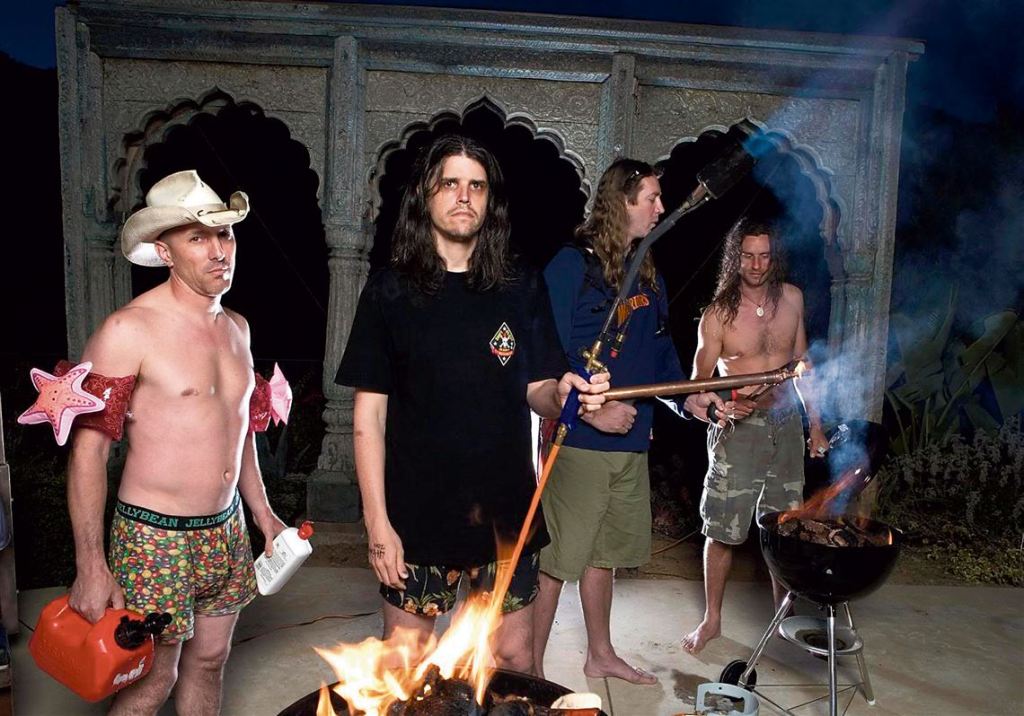
Carl Jung, sacred geometry and made-up philosophical books; it’s impossible to fully discern if metal’s biggest jokers are having you on or not. Their signature cryptic tension between profundity and ridiculousness is a finely balanced formula, and one created entirely by design. But to what extent have fans helped create and perpetuate this systemised mythology? Noiseland takes a deep dive into the enigmatic world of TOOL.
It’s no secret that humans, and most of all music fans, are naturally drawn towards that which intrigues us with its own obscured meaning and truth. There’s an innate human urge to understand that which evades obvious interpretation; an impulse which has been commercialised more than once before. If you sprinkle in some deepened ambiguity which borders on the sacred and the arcane, suddenly fans of rock and metal will be queuing around the corner.
That said, there’s no implication that the artists behind this deliberate mystery are doing so purely out of a commercial realisation there’s money to be made. It’s far more likely to be the result of the artistic male-urge to pursue elusiveness and perplexity within a body of work. It’s a self-fulfilling prophecy, of course. The further down the rabbit hole one goes, and the further insatiable fans will follow, desperate not merely to solve the truth, but to deepen the mythology which constructs an alternative reality far more exciting than our own.
But as with a lot of things which straddle the borders of overt sincerity, there’s the risk that constructing such an intricate web of mystery leaves you seeming contrived, or even lame. Take the example of British band Sleep Token; they may have built a legion of devoted fans inoculated with their unique brand of tepid metal, but the self-constructed mythology appears, from the outside, as being both labored and quite naff. The masks certainly don’t help either.
So what can be done to ensure you avoid the credibility land-mine of stilted elusivity? The answer is simple; ironic humour. Which brings us to the general ethos of Californian art-rock provocateurs and all round pranksters, TOOL. Beyond the obscure symbolism and philosophical allegories which have become their defining identity, their deliberate strategy of misinformation and social satire has created a unique ecosystem of ambiguity which survived (and thrived) through its own commitment to irony.
The journey began back in Los Angeles back in the late ‘80s, when singer Maynard James Keenan and guitarist Adam Jones were introduced via a mutual friend. After Keenan played Jones a tape recording of his previous live band, the latter was so impressed that he talked Keenan into forming a new band. They began playing together whilst simultaneously looking for a drummer and bassist.
Drummer Danny Carey happened to be living above Keenan and was introduced to the duo by Tom Morello, an old high school friend of Jones. According to Carey, he initially began playing with them out of pity when other musicians hadn’t been showing up to their audition calls. Eventually, a friend of Jones introduced him to bassist Paul D’Amour, completing the first iteration of the TOOL lineup.
And so began the fuckery. After performing their first shows and writing their early material, the quartet agreed on to fabricate the story that the groups come to being was driven by the pseudo-philosophy lachrymology. This belief system and apparent form of psychotherapy (which roughly translates as ‘the study or science of crying’) was based on the idea that the experience of pain and suffering were integral in the pursuit of enlightenment and spiritual growth. The band even went so far as to cite the obscure 1949 novel The Joyful Guide to Lachrymology by Ronald P. Vincent as the basis for their philosophical genesis.
But of course, it was all made-up. I mean, the study or science of crying? The Joyful Guide to Lachrymology? It might seem obvious in retrospect, but for years (and even some people on Reddit to this day) are trying to decipher it. Keenan would admit that the name is merely a euphemism for the male form; ‘Tool is exactly what it sounds like: It’s a big dick. It’s a wrench. We are – your tool; use us as a catalyst in your process of finding out whatever it is you need to find out, or whatever it is you’re trying to achieve.’ Before they’d even gained notoriety for their music, they’d set the precedent; infer profound meaning at your own risk.
The debut EP Opiate arrived in 1992, showcasing a heavy-metal sound and confrontational style on aggressive tracks like Hush and Sweat. Given they were initially marketed as a metal band by their label Zoo Entertainment, this initial sound would still gain them an early following in the Southern California area before it evolved into their complex idiosyncrasy. This unique edge would begin to materialise when TOOL announced their arrival to the wider scene with the release of their debut album Undertow in 1993.
As a more conventional heavy-metal album, Undertow arrived at a time when grunge was at the height of its popularity and pop-punk was beginning to gain commercial traction. If later albums would usher in the TOOL mythology, then their debut LP was about introducing the world to their aesthetic world. Undertow is an album of raw material and taboo themes; grotesque images, psychological darkness and a fascination with pain, trauma and repression. If the alienation being described by Cobain, Staley and co was a grounded misery, then TOOL’s dread felt strangely otherworldly.
It also introduced the viscerally striking visual world of guitarist Adam Jones, who served as the twisted mind behind some of TOOL’s most haunting music videos. Beginning with the directively named Prison Sex, which garnered significant controversy for it’s unflinching descriptions of child abuse. The surreal, body-horror influenced stop-motion animation for the music video is as visually elaborate as it is off-putting to this day, and would become a defining feature of their identity in years to come.
Truthfully, the mythology began to fully emerge during the release of their sophomore album Ænima in 1996. The penchant for transgressive themes and confrontational visual styles was moulded throughout the early years, along with their evolving collective interests in more metaphysical and spiritual subject matter. During this period the band forged a friendship with legendary comedian Bill Hicks who had become well-known for his polemical routines satirising a range of social issues involving religion, politics and philosophy. His influence would have a profound effect on the identity of Ænima.
There was such a surfeit of ideas introduced throughout the album that it quickly became a cryptic challenge for listeners to tackle. The outcome would be an LP which completely refuses to distinguish between profound symbolism and complete nonsense. Just look at the title; Ænima is a crude portmanteau of Carl Jung’s concept of the anima with the bowel relief device. This running idea of spiritual purification through bodily disgust appears several times across the album; most notably on Stinkfist, which is exactly what it sounds like, but also on the title track, both of which were accompanied by their own Jones’ directed visual nightmare. The Bill Hicks philosophy does permeate throughout but most prominently on said title track, in which his ‘Arizona Bay’ routine is referenced. The original idea was of the San Andreas fault collapsing, purging the continent of Southern California and the Baja Peninsula which would give Arizona its own oceanfront. TOOL reimagining into an odd fantasy in which this ‘hopeless fucking hole we call LA’ is deliberately disposed of in the toilet; ‘only way to fix it is to flush it all away’.
Jungian philosophy would appear throughout too, particularly on Forty Six & 2 where the concept of the shadow self is referenced. Jung stated that the ‘shadow’ was the unconscious mind wherein repressed, dark and hidden emotions festered, refusing to be acknowledged by the conscious self. Instead of denying or fighting the shadow-self, Jung argued that true psychological maturity and spiritual growth would only come by confronting and integrating parts of this entity into the conscious self. Seems earnest enough, right? Well, that’s the thing with Ænima. There’s multiple examples throughout wherein you’d be forgiven for initially taking the lyrical meaning at face value. But once you examine it, they start to become contradictory and bizarre, with deliberate ambiguity as to a material truth.
Lyrically, tracks like H and Jimmy are so obscured that on first listen it’s anyone’s guess as to their true meaning (obviously context does change this), whereas Pushit and Eulogy position themselves as grandeur theatrical compositions (which in length, they are), and build towards enormous crescendos of cathartic release. Even if it’s hard to tell whether the lyrics are earnest or not, musically they breathe with an honesty of their own. Pushit in particular has an especially operatic essence, drawing into a thrilling climax which ends with the powerful closing lyrics; ‘Remember I’ll always love you, as I claw your fucking throat away. It will end no other way, it will end no other way’. So where does the sincerity of these emotionally charged ballads get undercut?
The answer is in the album’s several interludes, which are as hilarious as they are vacuous. Probably the most iconic is the audibly terrifying Die Eier Von Satan, which lumbers with an industrial bassline, punctuated by sounds of a hydraulic press on a factory floor. As the sounds of cheering and applause rises, lyrics are delivered in German with increasing ferocity to a frenzied crowd. Spoken by Marko Fox, bassist for German band ZAUM, the interlude builds an insidious atmosphere which sounds unquestionably like a Nazi rally. Any German speaker would know immediately that in spite of Fox’s terrifying diction he is simply reciting the recipe for a traditional Mexican wedding cookie. But for the majority of us on first listen, it takes on a very different meaning.
The use of emotional juxtaposition is a common thread, as bizarre tracks like Intermission prelude the more personal themes on Jimmy. Another standout interlude is the hysterical Message to Harry Manback which plays out a voicemail recording of an Italian man berating someone for sleeping with his girlfriend, repeatedly wishing he dies of cancer. All this while set to a background of dissonant melancholic piano and the sound of waves crashing into a shoreline. On Useful Idiot, the vinyl copies of the album end with Side A in a locked groove, forcing the listener to intervene. This deliberate act to get fans participating in the joke and thus growing the mythology would become an increasingly prominent factor in later albums.
What we’re left with is an album laden with contradictions, veiled humour and unclear sincerity. But the progression from Ænima to Lateralus becomes clearer when we see the systemisation of this developing mythology and tension between profundity and inanity. If Ænima had been more of an aesthetic, then Lateralus evolved it into an intricate network of conceptual matter. Bill Hicks had passed away in 1994 after the release of Undertow, but his worldview was hugely formative in the album’s segues into genuine profundity, most notably on Ænima’s closing track Third Eye. The song behaves like a journey toward a higher consciousness, revealed in the album’s furiously delivered closing lyric; ‘prying open my third eye’, suggesting the journey to enlightened consciousness was one of imperative necessity. The mythology may not have been fully formed, but the formula certainly was. Ænima had established that TOOL could make profundity and absurdity indistinguishable; Lateralus would discover just how far that ambiguity could be systemised.
Lateralus arrived in 2001, five years after its predecessor. The gap between releases was down to a contract dispute, but would also serve as an unintentional catalyst for the mythology to deepen. TOOL’s insistence on privacy and refusal to provide meaning or context for their art led fascinated fans to start constructing their own meaning. As the internet was starting to become widely popularised, online theories and hypotheses began to circulate. In this sense, TOOL reached their commercial peak at the perfect moment, as they became one of the first bands to weaponise the internet. This was long before people realised how quickly misinformation could be disseminated online, and given the feverish anticipation for new material fans were ready to believe anything.
Which they did. In January 2001 TOOL announced that the new album would be titled Systema Encéphale and provided a 12-song track list with titles such as Riverchrist, Encephatalis, and Pain Canal. Almost immediately, file sharing websites like Napster were flooded with thousands of fake file names containing the tracklist titles. At first it seemed perfectly plausible; probably because the band had already trained their followers to expect obscure philosophical and anatomical song titles. According to the band’s FAQ site, the name of the album was even changed a second time the following day, now titled Evasion and featuring some less than discreet song titles such as Precipissed, Munge and Smell Me.
Before the album had even hit shelves, fans were not just contributing to the mythology; they were actively creating it. Thematically, it ushered in new concepts like numerology, kundalini, and chakras. If Ænima had been more interested in destruction and purification, then Lateralus was grappling with ideas of transcendence and expansion. The title track became well-known for its unorthodox structure, deploying the fibonacci sequence as the lyrical content encouraged the listener to move beyond a binary, linear understanding of the world and embrace ambiguity, intuition, experience and possibility. If this had appeared on Ænima then it’s more than likely that the profundity were an elaborate ruse, but the inclusion of mathematical coding made the whole album something which could be tangibly studied. There was no longer ambiguity as to whether there was anything at all buried within the complexity; TOOL were now actively telling listeners to go and seek it out.
In that sense, the album operates as something of a linear journey. Kicking off with powerful opener The Grudge, the lyrics explore themes of attachment and resentment by holding onto something negative which gives us power. This ulcerates into a frenzied ending in which you can experience Keenan’s famous 23 second-long scream, alongside a final declaration to ‘let go’. A few tracks later, the physical separation of the grudge and the true self occurs in the album standout, and possibly the groups’ most recognisable track Schism. Importantly, Keenan and co recognise ‘I know the pieces fit, cause I watched them fall away’; making this a process of transcendent reconstruction through the pursuit of truth.
By the time we reach the album’s second half, the spiritual trajectory is becoming more visible. On Parabola, we’re urged to confront something bigger than the self, and in turn understand our own role within it. While reality is temporary and the physical body may be a constant reminder of our own mortality, the listener is instructed to ‘recognise this as a holy gift and celebrate this chance to be alive and breathing’. The process of relinquishing, reconstructing and realigning the spiritual perspective is now complete, before Lateralus immortalises it into a directive mantra. It was a remarkably profound statement from a band who only nine months prior had had fervent fans downloading digital rips of a fake song called Smell Me. This is truly the point at which music became the tool, so to speak.
The visual identity was evolving in tandem; Adam Jones’ signature stop-motion fever dreams began to move towards a broader vision of physical totality, in which the body becomes a sacred object; most notably on the mesmeric visual companion to Schism. Of course, there remained a level of visual ambiguity which drew in fans like moths to a flame, especially given music videos were being played in heavy rotation of music channels at the time. By this point TOOL had solidified themselves as one of the most inventive provocateurs in the metal scene, as Lateralus transcended into the realms of art-rock. And then, right as they smashed through the glass ceiling, they disappeared.
Well, not disappeared. But the band stepped back and let the mythology become a self-sustaining life force. Each of the four band members turned their attention to other projects and were satisfied to let fans continue to grow the ecosystem of mystery unsupervised. And then, in 2003, frontman Keenan was hit with a personal tragedy which would be a defining creative diversion on their next album. By the time they returned in 2006 with 10,000 Days, the direction of the lyrical content had indeed shifted, but inverted inwards onto confronting the most personal of traumas: death.
The initial explanation behind the album’s meaning was given as the approximated time-scale of the Saturn Return, the cosmic moment at which one is confronted with the possibility to realign their mindset and let go of what previously was. This may have been true as the album’s meaning became a multi-faceted artifact, but the personal truth behind the title was the rough period of time which Keenan’s mother Judith Marie lived after suffering an aneurysm. This drawn out period of suffering and physical anguish is explored in detail across Wings for Marie (Pt 1) and 10,000 Days (Wings Pt 2). It’s a fascinating transposition from the inanity of their old tricks; by presenting something which on the surface demands analysis for some kind of obscured metaphorical message, but in reality is a deeply personal account of human grief.
Outside of the personal tragedy which dominated the thematic content of 10,000 Days, there was another focus on critiquing the problematic humanity has with suffering in general. On Vicarious, Keenan blatantly laments our tendency to ‘feed on tragedy’ and need ‘to watch things die from a good safe distance’. The Pot is an outright challenge on hypocrisy, challenging the listener to make confrontational an interpersonal task; ‘steal, borrow, refer, save your shady inference’. Ænima was TOOL criticising society at large, whereas 10,000 Days was microscopic in comparison, taking down the individual’s sense of moral authority. Right In Two closes with the sullen realisation that even transcendence might not have the capability to rescue us as a species, and that our innate tendency to split and divide from one another is our terminal undoing.
It seemed TOOL were beginning to embrace sincerity following the emotionally testing period of self-reflection between Lateralus and 10,000 Days; they had subverted their own formula by embracing a sincerity which tossed aside the humorous levity in the process. Or had they? Nah, they had not. The evidence for this is in the bonkers 11 minute cosmic opus of Rosetta Stoned, which packs so much lyrical slop into a dense spoken word encounter with an extra-terrestrial, only for the pathetic protagonist to get too stoned to remember it. This hilarious statement on the band’s force-feeding of profound information to fans, only to then remind them not to get too comfortable; remember who you’re dealing with here. It’s a pretty good place to leave dumfounded fans before they fucked off on their longest hiatus yet – thirteen years, or in TOOL speak, 4,700 days.
And yes, thirteen years is a long time in musical terms. As you can see by looking at YouTube comments, plenty of fans didn’t make it to see the day that TOOL returned in 2019 with the outstanding Fear Inoculum. But in the time it took for their fifth LP to finally materialise into something which fans could consume, the mythology had evolved into folklore. And crucially, it no longer belonged to TOOL. The fans had taken the mystery and turned it into a self-fulfilling prophecy of perceived profundity and deliberate deceit. What had begun as a labyrinth for bemused fans to scurry around like mice in an ethically questionably scientific experiment had metastasised into a Takeshi’s Castle-esque gameshow in which fans willingly took wrong turns, fell off the edges and got endlessly lost in the corridors of ambiguity. Could that have been TOOL’s intention all along? Good luck getting an answer out of them.

