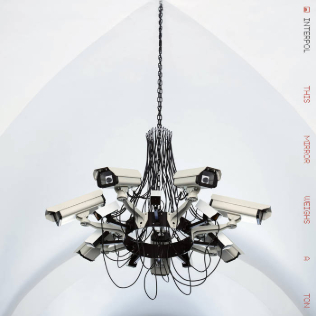
New York’s slickest gloomers debut on Partisan Records with an eighth LP which showcases a glorious union of experimentation and familiarity.
When Interpol stepped onto the stage at London’s Outbreak Festival last month, they might have been surprised to see the unfamiliar sight of Gen-Z fans singing along to Obstacle 1. Sure, the dad-rockers were still there, but this new legion of fans who undoubtedly discovered Turn On The Bright Lights via TikTok reels were out alongside them, in force.
Like Deftones, who headlined the festival later that day, the New York post-punkers are one of many bands benefitting from an organic exposure of new ears to their uniquely elegant sound. It’s not hard to infer just how cool the Interpol aesthetic is from seeing them take the stage in their black suits, as Paul Banks, the personification of this sleek aura croons through their 00s indie-rock classics which are enjoying a new life with this eager audience.
Banks and co seem to be aware of this newfound awareness, as the album’s title alludes to. Managing the weight of your own legacy whilst simultaneously trying to build on it is no mean feat. After their previous LP The Other Side of Make Believe was recorded with the band separated during COVID, they entered the studio in their beloved New York (for the first time in a decade) with the aim to try and capture something which felt more physical and live sounding.
Perhaps the return to their spiritual home drove the inspired recording of this album; Interpol have been one of NYC’s favourite sons for over two decades now. Their love of the city permeated throughout their early music, with striking visuals of liminal spaces and lyrics of brooding protagonists wandering the vast urban sprawl. This Mirror Weighs a Ton is equally pensive, but the lyricism is inverted; centering on themes of self-reflection and inward perception.
The opening title track is a surefire addition to their own pantheon of stunning album openers, driven by a hypnotic groove and a lush soundscape which feels extremely Massive Attack. Iron City moves with a similarly tripped out energy, as the usual guitar-first arrangements are swapped out for something more experimental; sounding nothing like anything they’ve produced before.
The distinctive low-end throughout the album is the work of touring bassist Brad Truax, who recorded the bass parts for the first time. Since the departure of the enigmatic former bassist Carlos Dengler in 2011, it’s been a feature of the group’s work which had been largely absent on their recent albums. Banks acknowledges the vast expanses of the basslines on the more trip-hop inspired tracks; ‘You can thank Brad for that.’
Probably the album’s greatest strength is that it’s not a drastic departure from their own graceful sound, but yet still feels like an offshoot into a refreshing new direction. Even by their own lofty standards, the New Yorker’s have found a way to tinker with their own tightly refined formula and in doing so, discover new ways to explore its outer limits.
For a group going through a popularity renaissance, it might have been easier to reimagine Turn On The Bright Lights for their new Gen-Z audience, a là The Strokes with The New Abnormal. Instead, This Mirror Weighs A Ton is a bold, fully cohesive effort which blurs the lines between experimentation and familiarity, showing there’s plenty more to come from post-punk’s most polished group.

