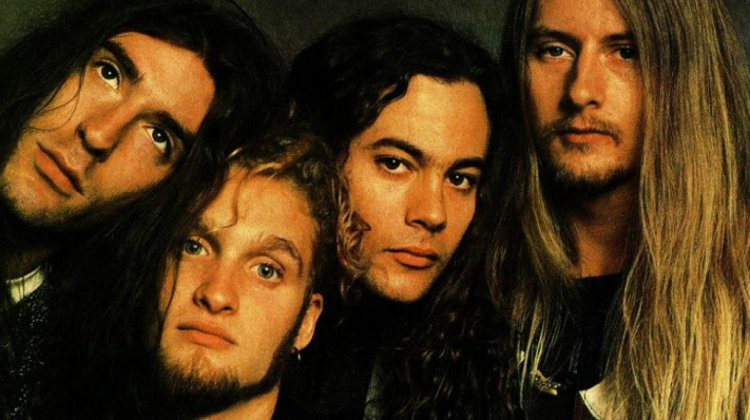
Kurt Cobain might have become the immortalised anti-hero for Gen-X’ers, but it was another Seattle band who typified the first-wave of grunge like no other.
If you were to have a poke around the dorm rooms of US colleges in 2026, you’d more than likely still encounter the enduringly famous portrait of Kurt Cobain smoking a cigarette over an acoustic guitar. Nirvana, and their tortured but magnetic frontman, still stand in the collective memory as being the definitive band to emerge from the grunge boom in the early 90s.
In terms of cultural impact, few could argue against that. But when we recall the true sonic identity of grunge (distorted, sludging guitars and bleak, angst-ridden lyrics), it was one of their contemporaries who come to mind as being the epitomical representation of this short lived phenomenon; Alice in Chains.
As the 1980s drew to a close in the United States, the economic landscape had shifted toward a pop-culture dominated climate rampant with consumerism. Reaganomics had ushered in a new wave of prosperity, and the Cold War was drawing towards its overdue conclusion. There was plenty of cause for optimism, as you’d expect.
But in Seattle, the mood was somewhat different. The infamous Boeing layoffs throughout the 70s and 80s had gutted the city of its industrial core, giving way to a new cultural identity of working-class resilience and hardship which was woven into the collective psyche of its 500,000 strong population and crucially, the youth which emerged from it.
Across the country, generation X’ers were reaching adulthood. This new cohort of emerging youth would become defined by a zeitgeist of ironic detachment and emotional minimalism. In Seattle, the sobering realism of life in the pacific northwest, which Jerry Cantrell himself described as having a ‘natural melancholia’ was crucial in molding the identity of grunge, which was a community long before it evolved into a genre. Members of other seminal bands like Pearl Jam, Mudhoney and Soundgarden were closely linked and frequently shared rehearsal spaces, live venues and audiences.
It was also a scene rooted in tragedy from the off. One of the most promising bands to break through the Seattle scene in the late ‘80s had already disbanded before the ‘90s had begun. Led by charismatic frontman Andrew Wood, Mother Love Bone had been the first group to sign with a major label. Wood wouldn’t live to see the release of their debut album Apple in 1990 on PolyGram, taken too soon via accidental overdose on the synthetic poison which would become darkly synonymous with the grunge scene; heroin.
But it was this tragedy which helped forge a deep sense of community long before grunge hit the mainstream. Mother Love Bone guitarists Stone Gossard and Jeff Ament would go on to form Pearl Jam with singer Eddie Vedder, who collaborated with Chris Cornell from Soundgarden on one-off project Temple of the Dog, a tribute to the late Wood. It was a far cry from the petty Britpop rivalries of the 90s. This was a scene defined by unity, support and brotherhood, albeit one which was permeated by a near constant feeling of impending tragedy.
Much like their contemporaries, Alice in Chains came from the dissolution of other projects. Long before the quartet released heart-wrenching ballads like Nutshell, they had been cutting their teeth within the culturally dominant hard-rock and glam-metal scenes. It all began after guitarist Jerry Cantrell who had been playing hard-rock with several bands in the Seattle area was introduced to Layne Staley, who was fronting glam-rock outfit Sleze. Cantrell had seen Staley perform years before and had been impressed by his powerful croon.
Both men had seen their respective bands break-up at a similar time so, after much persuasion from Cantrell, they agreed to form a new project. Drummer Sean Kinney, a friend of Staley’s, was recruited along with bassist Mike Starr to complete the first iteration of the band. The name was adapted from an early version of Staley’s glam-metal project, which supposedly came from some lewd joke about bondage and the titular character from Alice in Wonderland. That’s glam-metal for you, though.
The group had been on the radar of Columbia Records after promising live shows led to a tip-off from A&R rep Nick Terzo. After the promotional EP We Die Young became a hit on metal radio, Columbia fasttracked the production of their debut album. They were rushed into the studio with producer Dave Jerden, who would later recount their early sound; ‘I told Jerry Cantrell, ‘Metallica took Tony Iommi and sped him up. What you’ve done is you’ve slowed him down again’.
Their debut LP Facelift arrived in the summer of 1990. As the quartet started to hone in on a unique sound, the overall theme of the album represented a synthesis of glam-metal influence combined with what Cantrell described as the ‘moody aura’ that was a ‘direct result of the brooding atmosphere and feel of Seattle’. In that sense, Facelift had one foot still in the ‘80s; tracks like Real Thing and I Know Somethin (Bout You), have a distinct playfulness which would be otherwise unheard of in Alice in Chains future material. But the essence of the burgeoning Seattle sound was interlinked to hint at what was to come.
Whilst it did receive a relatively warm reception upon release, it would only be in retrospect that its impact would be fully realised (Ozzy Osborne would later include it in his top 10 metal albums). By bridging the gap between heavy metal and grunge, the scene was invariably set for the most significant cultural shift of the ‘90s; the release of Nevermind in September 1991.
It’s difficult to overstate the impact that Nirvana’s sophomore album had on the music industry. Almost overnight, unpolished aesthetics (and flannel shirts) became mass marketable. The image of the rockstar was completely shattered; gone was the overblown theatrics persona of ‘80s hard rock stars, and in came Cobain, the anti-rock star.
Perhaps it was indicative of generation X’s demand for authenticity which made Cobain’s detached insecurity so alluring; gone were the days of glamourising excess and oozing relentless machismo. Instead, Nevermind showed that vulnerability could sell millions of records. Ironically enough, being anti-commercial became commercial; a contradiction which Cobain famously hated.
Beyond the image, the album was musically accessible whilst maintaining a rawness which gave it the secret ingredient of so called authenticity. Take Smells Like Teen Spirit; it’s the perfect demonstration of this crossover appeal. There’s the Pixies-esque loud/quiet dynamic, heavily distorted guitars mixed with an objectively catchy pop-rock chorus, but all wrapped up in punk aggression and noise. Record labels took quick note; polished aesthetics were no longer a must-have, but rather the opposite.
Meanwhile, Alice in Chains were getting their own taste of super-stardom. Facelift, which had an initially modest commercial run, eventually made it to platinum after MTV playing Man in the Box on heavy rotation. They spent much of 1991 touring alongside big names like Van Halen as the group were still marketed by Columbia as a heavy metal band. But when Nevermind hit shelves, it led to a re-evaluation of their sound which had initially appeared to be a darker-than-average metal record, but was quickly understood to belong to the broader Seattle sound.
Whilst the other bands in Seattle’s so called ‘big four’ grunge bands were musically more indebted to some influences than others, Alice in Chains sat at the intersection. Nirvana were heavily influenced by punk, with a strong focus on irony and dark humour. Pearl Jam had a socially conscious and empathetic image to go alongside their stadium-ready classic rock. Soundgarden were dealing in the surreal and ambiguous, and were crafting a sonic identity which was more derivative of heavy metal and progressive rock.
AIC managed to pull all these elements together, along with the additional garage-rock influence of OG scene pioneers Mudhoney, to create a sound which touched all corners of the grunge blueprint. In doing so, they became the mathematical midpoint between the eclectic influences which spawned the genre. This dark fusion of sounds and lyrical suffering would be fully realised with the release of their defining LP in September 1992; Dirt.
We’ll just go ahead and say it outright; musically, Dirt is grunge. Thematically spanning across addiction, depression, alienation and self-destruction, it was a brutally honest amalgamation of the genre’s relentlessly bleak mythology.
While it was unsurprisingly interpreted by many commentators as being an album solely about heroin, Cantrell and Staley were quick to both acknowledge and challenge this take. Lyrically, the music didn’t seek to demonise dope as some external vice, but showcased a grim polarity between the bleak realism and self-destructive pleasures of addiction. That said, Staley would later express regret over the obvious lyrical content, admitting ‘I wrote about drugs, and I didn’t think I was being unsafe or careless by writing about them.’ Cantrell denied that Dirt aimed to romanticise the darkness of addiction, telling The Skinny in 2013 that ‘it was more of a warning than anything else’.
Invariably though, addiction is something of a recurring motif. Tracks like Dirt, God Smack, Angry Chair, Hate to Feel and Junkhead all tackle the subject in different ways, showcasing the complex relationship addicts have with their vice. As Staley puts it in the latter; ‘you can’t understand a user’s mind, but try with your books and degrees.’ If fans were hungry for authenticity, they certainly got more than they bargained for with Dirt. Layne Staley’s image was one of loneliness, addiction and physical decay formed through lived experience, giving the music an invariably bleak legitimacy.
The album also saw the birth of the iconic vocal harmony between Staley and Cantrell, which can be best observed on the power-ballad Down in a Hole. The contrast in their voices gave the music a haunting duality, as if there were two voices trapped within the same tortured mind. On Dirt it serves as a powerful sonic tool, projecting the album’s composite themes into a sound which was at its core, strong. But as addiction took its toll, it became a harmony increasingly defined by an insidious weakening of Staley’s vocal powers, which would be stripped back and replaced by an achingly melancholic croon.
Dirt was a critical and commercial landmark for Alice in Chains. They quickly became one of the biggest bands in the world, as the album went 5x platinum in the United States. Atop this, they were added to Ozzy Osborne’s tour as the opening act.
In January 1993, the band parted ways with bassist Mike Starr. It would only be revealed years later that he was fired following an incident in Brazil, when the group were on tour with Nirvana. Starr, Staley and Cobain had been shooting up together, when at some point Starr collapsed and went into cardiac arrest. A distraught Staley performed CPR and ran a cold shower over, miraculously reviving him after being clinically dead for eleven minutes. Starr recalled waking up to find Staley hysterically crying over him. Whether this harrowing incident was the sole driver to Starr’s exit is unclear, but it was yet another sombre reminder of just how entrenched both men were in their addictions, and how deeply embedded heroin was within the grunge scene.
1993 was a year of semi-constant touring for Alice in Chains. By the time they re-entered the studio in early ‘94, the raw aggression had been stripped away and replaced with acoustic guitars. The resulting Jar of Flies EP felt like an inverse of Dirt. Quintessentially it was still grunge, but a deconstructed form of their own sound which retained its bleak core whilst adding a poignant tenderness. It could have been partially due to the hectic tour schedule, but there was a physical exhaustion in Staley’s voice which was starting to feel terminal. The alienation and vulnerability were still present, but this time there was a sense of hopelessness and resignation starting to break through the skin.
Cobain, unable to reconcile with the fame which he had inadvertently brought onto himself with his despondent image and creativity, committed suicide in April 1994. This is now widely considered to be the symbolic end point for first era of grunge. Soundgarden were moving towards more arena-friendly mainstream production, and Pearl Jam were busy hammering the commercial self-destruct button in their much publicised feud with Ticketmaster. Alice in Chains were largely inactive in the second half of 1994 and much of 1995 as Staley entered rehab.
AIC would manage one final album, a self-titled work released in 1995 and affectionately named Tripod by fans on account of the album’s cover showing a three-legged dog. If Facelift held onto some of the hard-rock swagger of the 80s and Dirt was a head-first dive into the darkness, then the overwhelming feeling of Tripod was claustrophobia. The whole record had a creeping, swamp-like atmosphere where songs didn’t propel themselves forward, but rather lurched and crawled; take Frogs and Sludge Factory as examples. The introduction of new bassist Mike Inez brought a massive low-end to the album, giving it a distinct murky thickness adding to the already unsettling atmosphere.
Alice in Chains final public appearance came in 1996 with their now immortalised concert for MTV’s Unplugged series. Staley, who made his first public appearance in months, appeared on stage wearing fingerless gloves to hide the track marks up his arms. His deteriorated physical state was blindingly clear, as he sang through acoustic versions of Would?, Rooster and Over Now with vacant detachment. Yet his haunting croon was still there, but now buried under a thick layer of insurmountable melancholia. It’s heavy stuff, as if watching a man sing at his own funeral.
This was to be the last time Staley was seen in public. He retreated to his Seattle condo, living a reclusive hermit existence following the death of his ex-fiancee Demri Parrott in October 1996. This would be his final resting place, as he finally succumbed to a speedball overdose in 2002. Whilst the group never officially disbanded, Cantrell, Kinney and Inez turned their attention to other projects.
Staley remains in the collective memory as the tormented addict, but as Kinney told Drum Magazine in 2011, this was not entirely reflective of just how desperate the situation was for everyone; ‘he was the focal point, like singers are. So they’d single him out. But the truth was, it was pretty much everybody. I definitely had my hand firmly on the wheel going off the cliff.’ Alice in Chains did reform in 2006 with new vocalist William DuVall, but in truth never managed to fully recapture the same musical potency they once held.
Looking back at the grunge explosion, there is one factor which defines both Alice in Chains and Nirvana’s brief reign at the top: impermanence. They burned bright, but it was never built to last. Part of grunge’s inimitable appeal is its bleak realism. Sad as it may be, this dark authenticity of lived experience is totally non-conducive to any kind of longevity. What was left behind, however, is eternal. Cobain and Nirvana may have been the spiritual face, but Staley and Alice in Chains were, and still are, the defining sound of grunge music.

